
Crosswords or Sudoku? Here's What Actually Works.
Playing isn't just for kids.
It is actually serious business for anyone over 50.
We know that when you retire or work slows down, the brain gets less stimulation. The risk? The machine gets a little rusty. Science shows that just 20 minutes of stimulation a day is enough to maintain neurons and your "cognitive reserve."
The problem is finding what to play. There are tons of memory games for older adults online, but they are often full of ads or require complicated sign-ups.
Here is a selection of 8 free activities—some online, some in your living room—to keep your mind bright.
Why Play is Your Best Medicine
Games trigger the "reward circuit." When you solve a Sudoku or win a card game, your brain releases dopamine. That is much better than forcing yourself through a boring drill.
The goal isn't just high scores. The goal is to surprise your brain. If you've done crosswords for 20 years, your brain does them on autopilot. To grow, you need to switch it up: go from verbal logic to visual or spatial logic.
Top 8 Games to Mix It Up
Here is a mix of activities to spark all areas of the brain.
1. Concentration (Touch or Cards)
The classic. Play online or with a real deck of cards face down.
- The Goal: Find the matching pairs.
- The Benefit: Works on immediate visual memory and spatial tracking (where was that card?).
2. Crosswords
A timeless classic.
- The Goal: Fill the grid using clues.
- The Benefit: Maintains semantic memory (general knowledge and vocabulary). Great for avoiding that "what's the word?" feeling.
3. Pictionary (Drawing Game)
Play with family or friends.
- The Goal: Make others guess a word by drawing it.
- The Benefit: Uses abstract thinking and hand-eye coordination. Plus, it's social, which is vital for mood.
4. Chess (Beginner Level)
You don't need to be a pro. Just learn the basic moves.
- The Goal: Checkmate the king.
- The Benefit: Pure planning. You have to anticipate the other person's moves. It is the king of logic games.
5. Object Sort (Organization)
Also find all of our online cognitive games, ad-free.
A simple home game. Mix a pile of buttons or screws.
- The Goal: Sort them by color, size, or shape as fast as possible.
- The Benefit: Works on executive functions and processing speed.
6. Charades
- The Goal: Guess a word from clues.
- The Benefit: Mental flexibility and association of ideas.
7. Tai Chi + Math (Dual Task)
This is the most powerful one. Do slow movements (like Tai Chi or stretching) while reciting a list of words or counting backward.
- The Benefit: "Dual tasking" is the best protection against falls and cognitive decline. You force the brain to manage the body and mind at the same time.
8. Categories
Pick a letter (e.g., "M") and categories (City, Name, Fruit).
- The Benefit: Retrieval speed. You have to be fast to find the info stored in your brain.
Go Digital Intelligently with Daily Brain Coach
These games are wonderful. But they have a flaw: they don't keep records. When you finish a crossword, it goes in the trash. You don't know if you are better than yesterday.
That's where Daily Brain Coach completes your routine. Think of it as a digital health journal for your brain.
- You Play: 2 to 5 minutes of validated cognitive games.
- We Measure: The app records reaction time and accuracy.
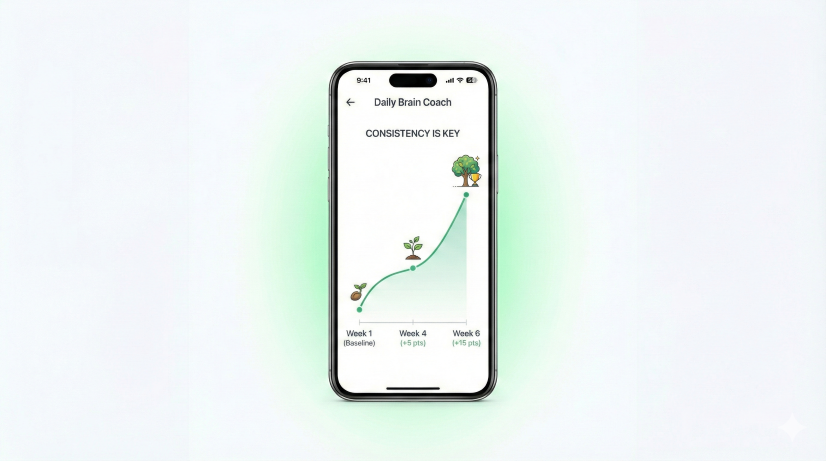
- We Compare: You see your evolution over the week or month.
Unlike disposable free games, Daily Brain Coach builds your profile over time. It's the difference between jogging randomly and having a coach who times your laps.
Why Variety Is the Key — Not Repetition
This is the paradox of cognitive games: once you master an activity, it loses its effectiveness. Your brain no longer needs to produce effort — it automates.
Neuroscientists call this the ceiling effect: once you plateau on a task, continuing to practice maintains the skill without developing plasticity.
The solution: rotation and novelty. Alternating between games that target different circuits forces the brain to constantly adapt.
Comparison Table: Which Game Activates What
| Game | Working Memory | Speed | Inhibition | Long-term Memory |
|---|---|---|---|---|
| Memory / pairs | Yes | Partial | No | No |
| Crosswords | No | No | No | Yes |
| Sudoku | Partial | No | Partial | No |
| Chess | Yes | No | Yes | Partial |
| Stroop Test | No | Yes | Yes | No |
| N-Back | Yes | Partial | Partial | No |
| Dual Task (Tai Chi + recall) | Yes | Yes | Yes | No |
The dual task (game #7) is the most comprehensive because it forces simultaneous coordination of multiple circuits. It is also the hardest — which is why it best protects against falls according to Sherrington et al. (2017, British Journal of Sports Medicine).
The Problem With Paper Games: No Measurement
Crosswords and Sudoku have a major flaw: they do not measure your progression. When you finish a grid, you do not know if you are better than yesterday.
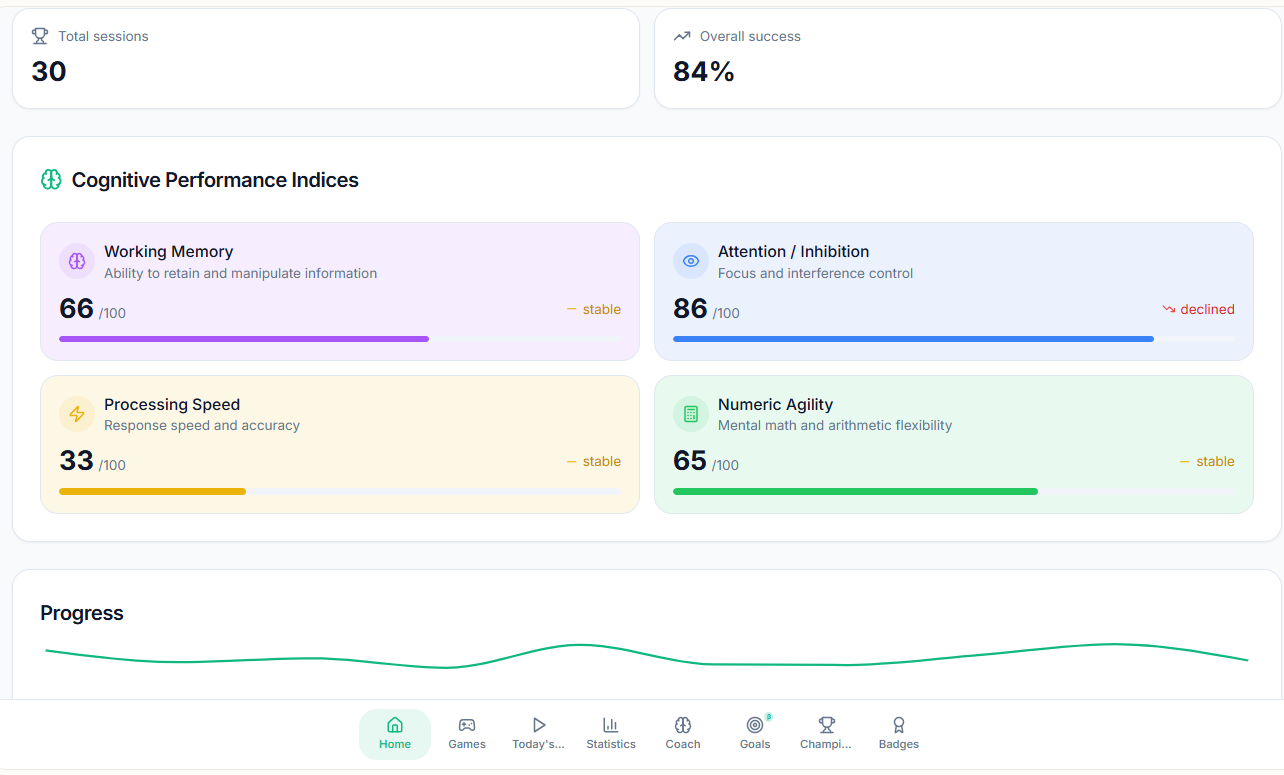
The cognitive indices dashboard automatically measures four dimensions after every session:
- Memory index: composite visual and sequential working memory
- Attention index: based on Stroop and selective reaction time
- Speed index: processing speed on visual search exercises
- Numeric index: accuracy on mental math tasks
Seeing your curve progress over a month is more motivating than any raw score.
The Ideal Routine: Combining Analog and Digital
- Morning (5 min): Daily Brain Coach — attention and speed, fresh brain
- Afternoon: social game or manual activity — episodic memory and social connection
- Weekend: chess, Pictionary or board games with family — executive functions and pleasure
Start your free session — no account, no credit card.
Conclusion
Variety is key. Play cards on Sunday, do some gardening on Wednesday, and adopt a daily digital routine with Daily Brain Coach.
This diversity keeps your brain young and adaptable. Don't just consume games—use them to progress.
Curious about your score?
Test our cognitive games with built-in tracking now.