
Dual-Task Games: How to Train Your Brain to Handle Multiple Tasks Simultaneously
Dual-Task Games: Train Your Brain to Handle Multiple Tasks
Have you ever felt that mental overload when you need to do several things at once — walking while talking, cooking while watching the kids, taking notes during a meeting? This ability to manage multiple tasks simultaneously is called dual-task performance, and it can be trained.
Dual-task games are cognitive exercises that challenge your brain on two fronts at the same time. Unlike classic cognitive games that target a single function (memory, attention, calculation), dual-task games replicate real-world situations where you must share mental resources between multiple activities.
What Is Dual-Task Cost — and Why It Matters
When you perform two tasks simultaneously, your performance decreases compared to a task done alone. This degradation is called dual-task cost:
Dual-task cost (%) = Single-task performance − Dual-task performance
For example, if you score 90% on a memory test alone but only 65% when asked to count beeps at the same time, your dual-task cost is 25%.
A high dual-task cost (>30%) can indicate:
- Chronic cognitive overload
- Increased fall risk in seniors (validated by Beauchet et al., 2009, Journal of Motor Behavior)
- Difficulty returning to work after stroke or traumatic brain injury
- An early sign of mild cognitive impairment
The Neuroscience of Dual-Tasking
What happens in the brain when you dual-task? The central executive — managed primarily by the prefrontal cortex — acts as the brain's conductor, allocating attentional resources between competing tasks. When two tasks demand the same neural resources simultaneously, interference occurs.
| Brain region | Role in dual-tasking |
|---|---|
| Dorsolateral prefrontal cortex (dlPFC) | Task switching and resource allocation |
| Anterior cingulate cortex (ACC) | Conflict monitoring, error detection |
| Cerebellum | Motor-cognitive coordination |
| Fronto-parietal network | Working memory under divided attention |
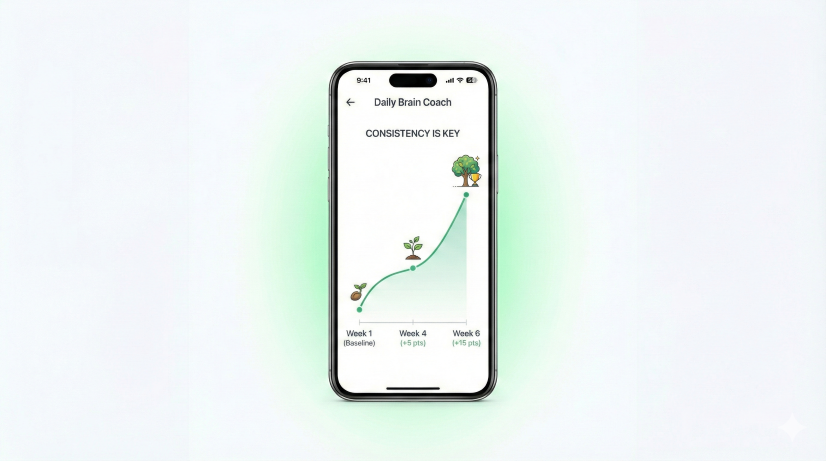
The good news: this system is trainable. Studies show that dual-task training produces structural changes in prefrontal connectivity over 6–8 weeks of regular practice.
The 3 Most Effective Types of Dual-Task Games
1. Dual N-Back: Working Memory + Auditory Attention
Dual N-Back combines a visual memory exercise (letters to memorize) with an auditory counting task. You must identify when a letter matches the one from N positions back while simultaneously counting auditory beeps.
Why is it challenging? Your brain uses two distinct systems: the fronto-parietal network for visual working memory, and the auditory cortex for sound processing. Coordinating these two systems intensely challenges the central executive.
Practical applications: Students taking notes during lectures, professionals following presentations while noting key points, seniors maintaining conversation while walking.
2. Dual Stroop: Cognitive Inhibition + Motor Coordination
Dual Stroop combines the Stroop Test (identify the ink color, not the written word) with a rhythmic motor task. The Stroop test engages your prefrontal cortex to inhibit automatic word reading. Adding a motor rhythm forces coordination between executive function and cerebellar timing.
Validated clinical applications: Fall risk prevention (Montero-Odasso et al., 2012), early Parkinson's detection, and driving ability assessment.
3. Dual Vigilance: Immediate Memory + Target Detection
Dual Vigilance asks you to memorize a sequence of 3–7 items while detecting target shapes that appear randomly. Your hippocampus (memory) and vigilance network (sustained attention) compete for attentional resources — the core of real-world multitasking demands.
How Dual-Task Training Improves Daily Life
A 2019 study on multitasking professionals showed that dual-task training 3 times per week for 8 weeks reduced perceived cognitive overload by 32%.
Key figure: A dual-task cost >25% in people 65+ is associated with a 2.3× increased fall risk (Beauchet et al., 2009). Dual-task training directly reduces this risk.
After a stroke or TBI, patients often report "no longer being able to do two things at once." Standard cognitive tests may be normal, but dual-task reveals the deficit — and provides a structured path to recovery.
How to Measure Your Dual-Task Progress
| Dual-task cost | Interpretation | Recommendation |
|---|---|---|
| 0–15% | Excellent | Increase difficulty |
| 15–25% | Good | Maintain level |
| 25–35% | Average | Regular training advised |
| >35% | High | Consider professional consultation |
Optimal Training Frequency
- Beginner (4–8 weeks): 2 sessions/week, 5–10 min each. Start at level 1.
- Intermediate (2–6 months): 3 sessions/week. Alternate between dual-task types.
- Advanced (>6 months): 2–3 sessions/week for maintenance. Target dual-task cost <15%.
Dual-Task and Your Cognitive Indices
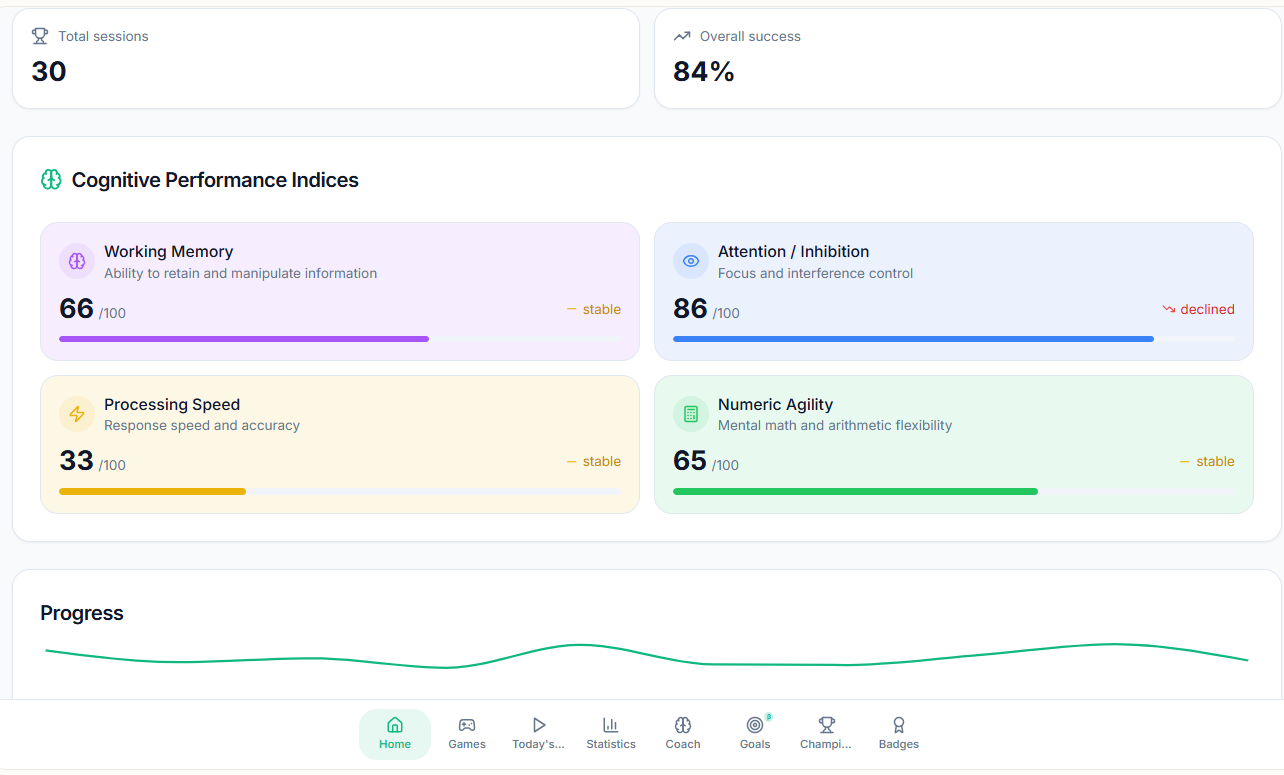
Track your dual-task improvements via your cognitive indices — four objective measures (memory, attention, speed, numeric) updated after every session. The attention index is particularly sensitive to dual-task training gains.
You can combine dual-task sessions with N-Back for working memory, Stroop Test for inhibition, and Word Search for visual scanning speed.
Access to Dual-Task Games
Unlike classic games, dual-task games are reserved for Premium subscribers. They require complex generation algorithms and advanced metrics.
With a free account, access 18 games including Stroop Test, Word Search, N-Back, Letter Memory, and Simon.
Discover Premium plans — From $4.90/month
Conclusion: Why Add Dual-Task to Your Cognitive Routine
Dual-task games replicate the cognitive reality of the modern world. Scientifically proven benefits: 25–35% reduction in perceived mental load and early cognitive decline detection. The secret is consistency: 3 sessions per week for 6–8 weeks produces measurable results. Start with your free trial and track your progress via cognitive indices.
Scientific references:
- Beauchet, O., et al. (2009). Journal of Motor Behavior
- Montero-Odasso, M., et al. (2012). Archives of Physical Medicine
- Baddeley, A., & Hitch, G. (1974). Psychology of Learning and Motivation