
Do You Need a Memory Coach or Just a Routine?
Between 50 and 60, you are likely at the peak of your activity.
You handle complex work, family life, maybe aging parents. Yet, this is exactly when the first "glitches" show up. A name on the tip of your tongue, a missed appointment.
Millions of seniors worry about their memory. Most of the time, it's not a disease—it's a lack of strategy. Your brain has changed, but you are using it the same way you did at 20.
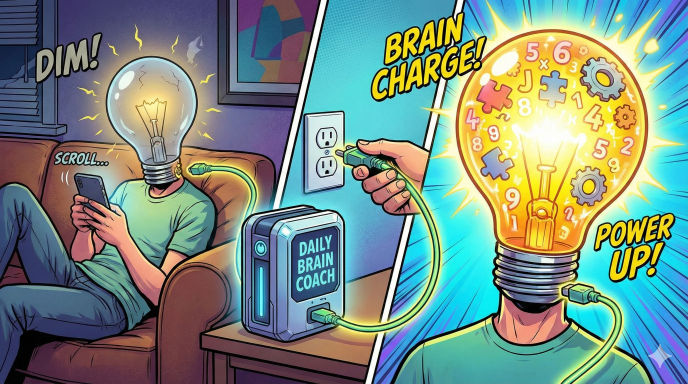
This is where a memory app for seniors acts as a coach. It's not just a puzzle book. It is a system that adapts to your strengths and weaknesses to secure your brain capital.
Why a Coach Beats a Simple Game
If you go to the gym and lift random weights, you might get hurt or see no results. The brain is the same.
Doing crosswords daily is fine, but it mainly works your vocabulary. If your issue is attention span or visual memory, you aren't fixing the problem.
A digital coach like Daily Brain Coach uses a multi-domain approach. It spots what needs work:
- Selective Attention: Focusing despite background noise.
- Working Memory: Holding info long enough to use it (like a gate code).
- Processing Speed: Reacting quickly to new info.
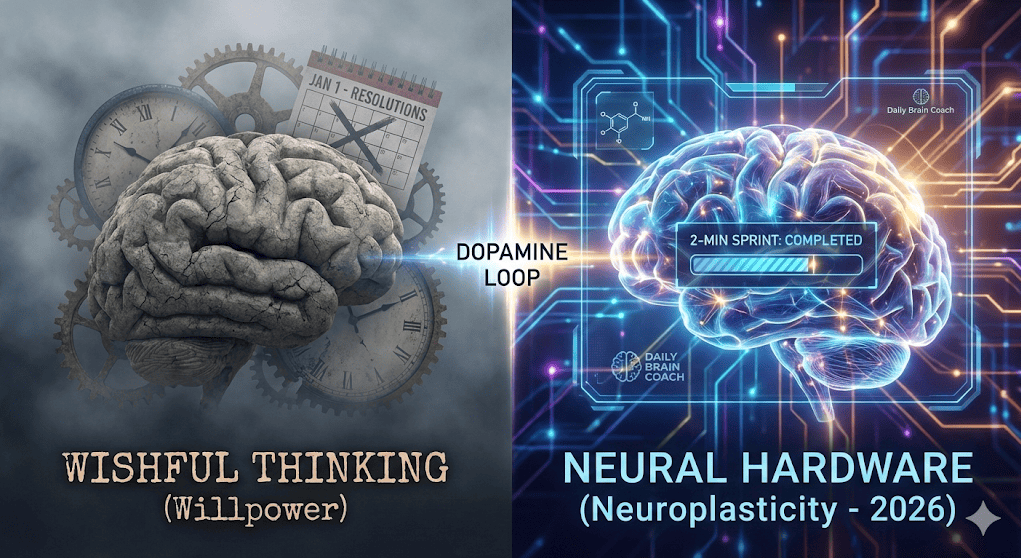
Plasticity only happens if the effort is targeted. The coach aims for you.
These exercises are integrated into our progressive brain games, adapted to each person's level.
How Daily Brain Coach Works Daily
Forget confusing medical charts. Daily Brain Coach speaks plain English. The app analyzes how you play to give practical tips.
Here is what our algorithm might tell you after a session:
After a concentration game:
"Your focus is excellent this morning (+20% vs last week). However, you hesitated on colors. Try our symbol counting module to sharpen your eye."
After a missed memory round:
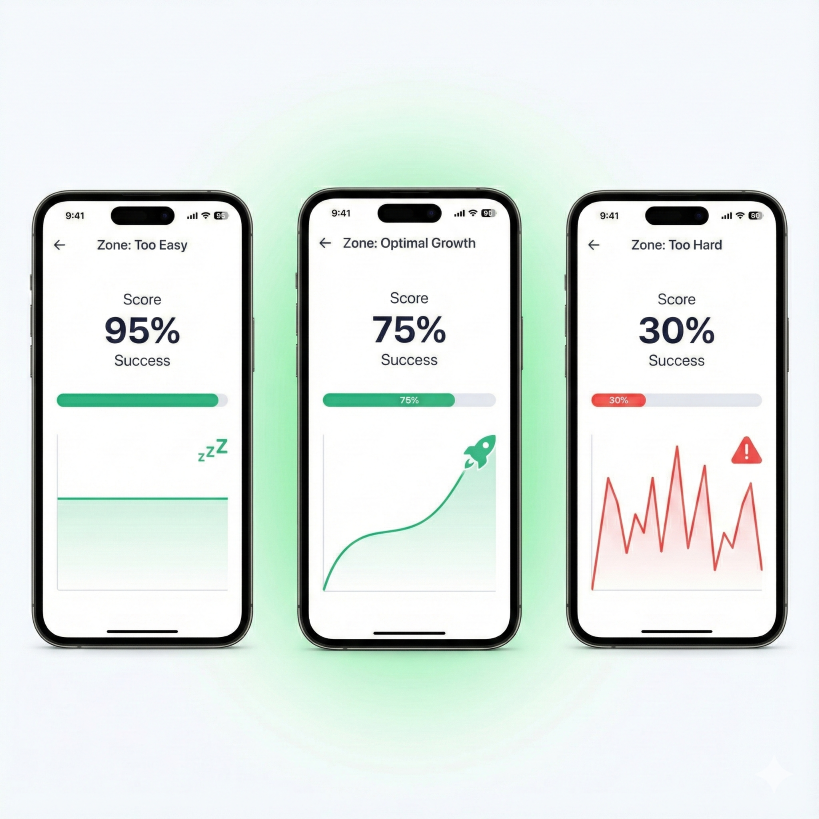
"No problem. The list of 7 words was too long. We will drop to 5 words tomorrow to rebuild the foundation. Take time to visualize each word as an image."
That's the difference. The app doesn't judge you on a raw score. It guides you for the next time.
A Routine That Fits Your Life
At 55, nobody wants "homework." The benefit of digital is flexibility.
Your coach is in your pocket. You launch a 3-minute session on the bus or while waiting for the coffee to brew.
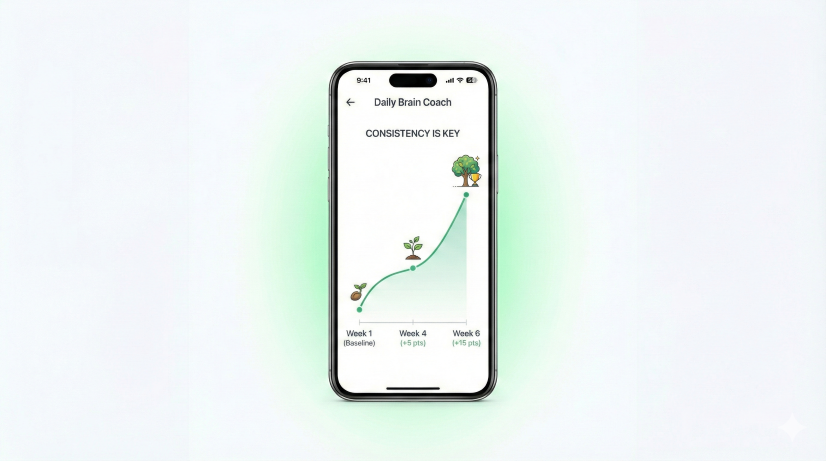
The value is long-term. It is motivating to look at your dashboard after 3 months and see: "Visual Memory: +15% success." You don't notice daily progress yourself. The coach sees it and shows you. That changes your motivation.
The 4 Cognitive Functions That Decline First After 50
Not all aspects of memory decline at the same rate. Understanding which are most vulnerable lets you target your training intelligently.
1. Working memory — the ability to temporarily hold information while using it (a phone number just heard, a mental grocery list). It begins declining as early as 45–50 according to the meta-analysis by Salthouse (2010, Neuroscience & Biobehavioral Reviews).
2. Processing speed — how fast the brain processes and responds to information. This is often the first perceptible sign: you take longer to find the right word, you hesitate before answering.
3. Episodic memory — memories of personal, time-stamped events. "What did I eat Tuesday evening?" becomes harder, while old memories stay intact.
4. Cognitive inhibition — the ability to ignore irrelevant information. This is why following a conversation in a noisy café becomes harder with age.
The good news: these four functions are precisely what the Daily Brain Coach program targets — with specific exercises for each.
Why Crosswords Alone Are Not Enough
Crosswords are excellent for maintaining vocabulary and semantic memory. But they do not target working memory, processing speed, or cognitive inhibition.
This is what neuroscientists call the transfer effect: getting better at a task does not necessarily mean improving the underlying functions. For real transfer to daily life, you need to target the deficit circuits directly.
| Activity | Working Memory | Speed | Inhibition | Episodic Memory |
|---|---|---|---|---|
| Crosswords | No | No | No | Partial |
| Sudoku | Partial | No | No | No |
| Stroop Test | No | Yes | Yes | No |
| N-Back | Yes | Partial | Partial | No |
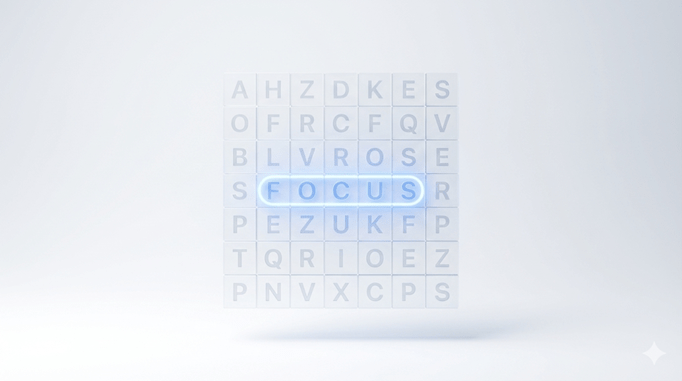
| Word Search | Partial | Yes | Partial | Partial |
| Multi-game program | Yes | Yes | Yes | Yes |
A multi-domain program covers the full spectrum where a single activity cannot.
What Your Dashboard Scores Actually Mean
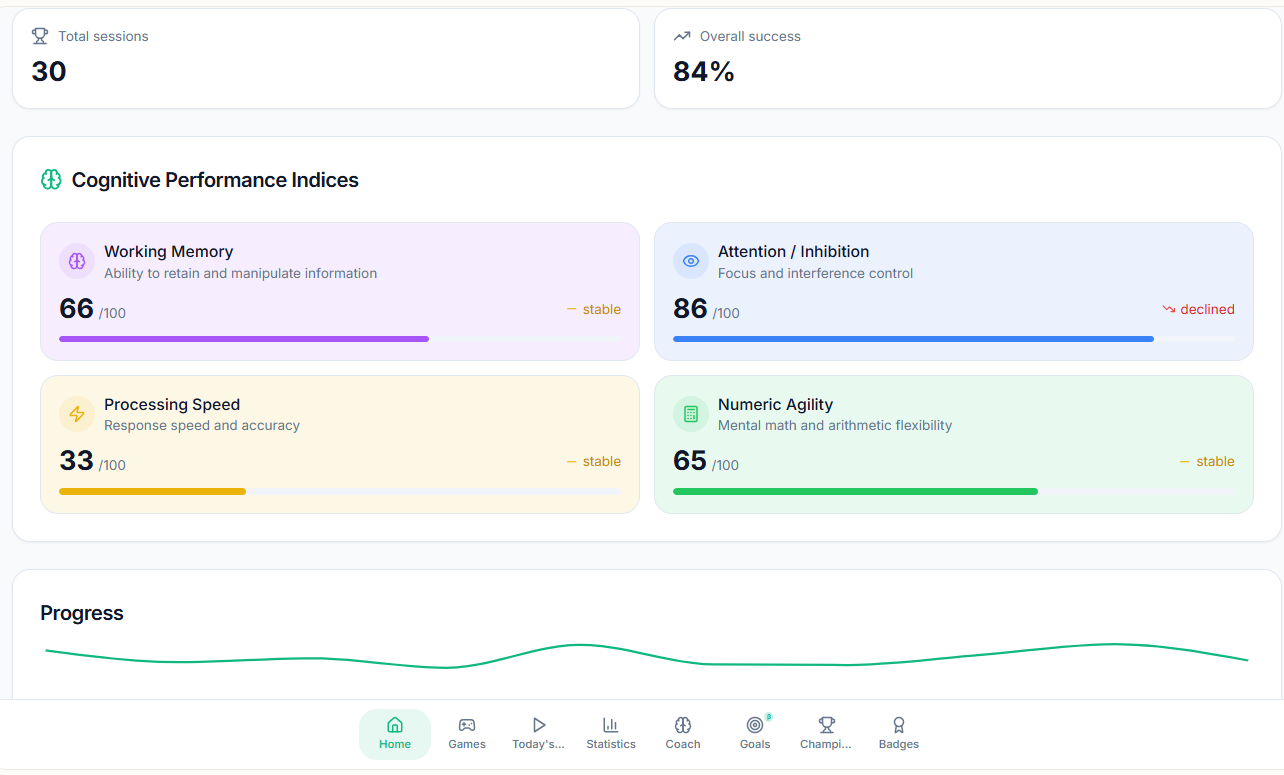
Most apps display a raw score (7/10, 82%) without explaining what it represents. Daily Brain Coach calculates four cognitive indices based on your real performance:
- Memory index: composite of N-Back and sequence memory scores
- Attention index: composite Stroop and selective reaction time
- Speed index: processing speed on visual search exercises
- Numeric index: accuracy and speed on calculation tasks
These indices are calculated on a rolling 30-session window — they reflect your real trend, not your mood on any given day. An index that rises 5 points in a month represents a measurable neurological improvement.
Sleep and Nutrition: The Forgotten Multipliers
No cognitive training program compensates for poor lifestyle habits. Two factors have a direct impact on memory:
Sleep — during deep slow-wave sleep, the hippocampus replays the day's events and consolidates them into long-term memory. Sleeping less than 6 hours significantly reduces the benefits of cognitive training.
Omega-3 fatty acids (DHA in particular) form neuron membranes. A deficiency slows synaptic transmission. Oily fish (sardines, mackerel, salmon) 2–3 times per week is sufficient.
Start your free training session — 5 minutes, no account required, results visible within 2 weeks.
Conclusion
At 50, prevention is your best investment. Don't let small lapses settle in and eat your confidence.
Getting a memory coach means deciding to stay in charge of your mind. With Daily Brain Coach, you have a supportive expert by your side, every day, for just a few minutes.
Your first personal assessment is waiting.
It's free, no commitment, and starts now.