
Pros: Modernize Your Cognitive Therapy Sessions.
Digital cognitive rehabilitation is booming.
Tools like Constant Therapy, HappyNeuron Pro, and HeadApp have transformed how SLPs (Speech-Language Pathologists) and OTs (Occupational Therapists) work.
But sometimes, you don't need a Ferrari; you just need a reliable bicycle.
Speech Therapy Homework App: Engage Patients at Home
The Landscape of Professional Tools
HappyNeuron Pro / Constant Therapy are comprehensive clinical platforms. They offer deep assessment modules, clinician dashboards, and specific protocols for aphasia or TBI. They are powerful, but can be expensive and complex to set up for every single patient.
Daily Brain Coach is the lightweight alternative.
Where Daily Brain Coach Sits in Your Toolkit
Think of us as the "home workout" to your "physical therapy session." We are not a clinical platform that diagnoses conditions. We are an engagement tool.
1. The Pre-Session Warm-up
Use Daily Brain Coach for 2-5 minutes in the waiting room or at the start of a session. A quick Symbol Match or Stroop task wakes up the executive functions and gets the patient focused and ready for deeper work.
2. Maintenance & Aging
For clients with MCI (Mild Cognitive Impairment) or normal aging who need general stimulation rather than specific rehab protocols, clinical apps can feel too "medical." Our consumer-grade UX is friendly and non-threatening.
3. Improving Adherence
The interface is polished and gamified. This improves homework compliance compared to dry clinical apps. Patients are more likely to practice attention tasks if they feel like games rather than tests.
For caregivers looking to support their loved ones, see our guide on brain training for dementia caregivers.
Why Digital Homework Outperforms Paper
Therapeutic adherence with paper worksheets is notoriously low. Research on cognitive rehabilitation consistently shows that gamified digital homework significantly improves patient engagement compared to traditional handouts.
Three key ingredients: immediate feedback, phone-based accessibility, and adaptive difficulty. Daily Brain Coach combines all three without requiring a clinical login or complex patient setup.
Cognitive Domains Most Relevant for Therapy Homework
| Therapeutic target | Cognitive domain | Daily Brain Coach exercise |
|---|---|---|
| Attention & executive function | Response inhibition | Stroop Test |
| Working memory | Verbal / visual WM | N-Back, Letter Memory |
| Processing speed | Visual scan speed | Word Search |
| Numeric reasoning | Calculation under pressure | Mental math tasks |
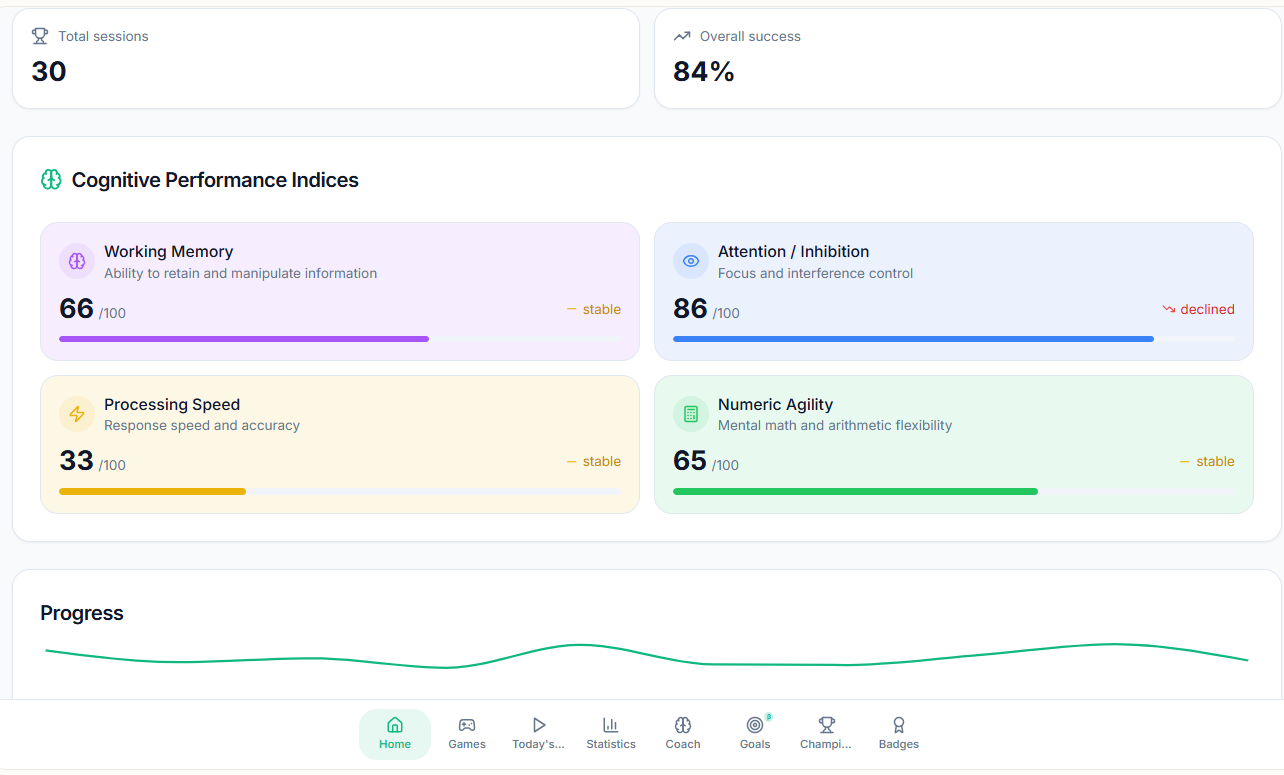
Each session produces a cognitive indices report the patient can bring to the next visit — concrete data on what they practiced and how they performed, without any data entry on your part.
Practical 3-Step Protocol
1. Prescribe: At session end, tell the patient: "Play the Symbol Search and Sequence games 3 times this week, 5 minutes each."
2. Execute: Patient plays on their phone or tablet. Interface is designed for 60+ users — large tap targets, simple navigation, no cognitive overload from the UI itself.
3. Review: At the next visit, open the cognitive indices together. Ask: "Your attention index went up 8 points this week — what did you notice at home?"
This loop builds therapeutic alliance and gives you objective adherence data without any clinical system setup.
Enhance your practice with lightweight tools. Free trial — no setup required.