
ADHD or Just Distracted? The 5 Games That Actually Help.
Train Your Attention Span: Games for Deep Focus
Let's be real: the modern college experience is basically sensory overload.
By midterm season, your brain feels fried. Discover our online concentration exercises for students.
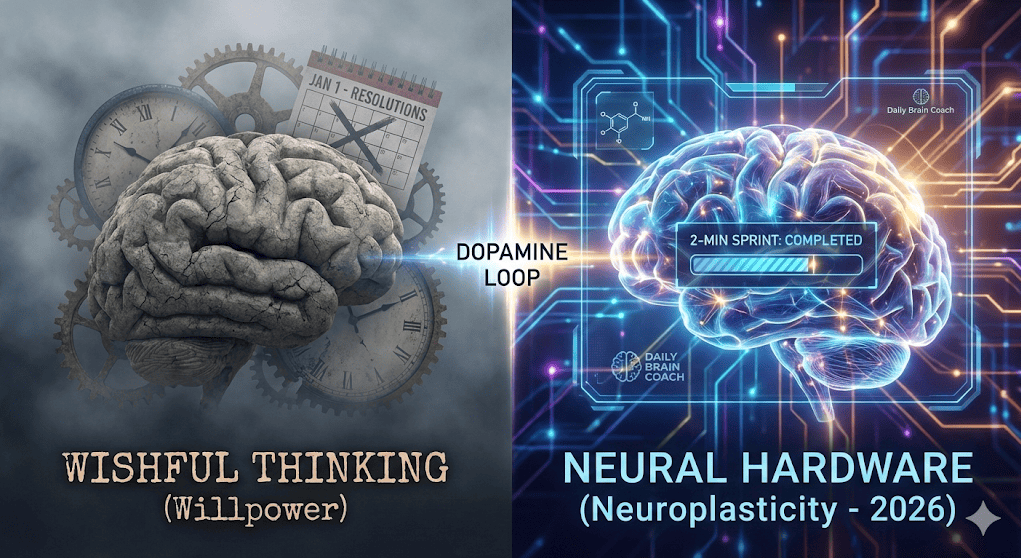
That's the "transfer problem," and it's why so many brain games fail.
But neuroscience shows that the right kind of cognitive training works.
Top 6 Proven "Games" to Sharpen Student Attention
1. The Color-Word Stroop Task (Inhibition)
Tap the color, ignore the word. The Stroop Test specifically activates the anterior cingulate cortex (ACC) — the brain's conflict-detection system — forcing it to override an automatic response. This is exactly the neural circuit that fails when you read the same paragraph five times without retaining anything.
2. N-Back & Number Sequences (Working Memory)
Recall sequences in reverse order. The N-Back task is one of the most studied working memory protocols in cognitive neuroscience. Jaeggi et al. (2008, PNAS) showed that consistent N-Back training produced measurable gains in fluid intelligence — the ability to reason through new problems, not just recall memorized facts.
3. Symbol Matching Speed (Processing)
Spot the odd one out under time pressure. Try our online processing speed exercise.
4. Rapid Calculation Bursts
Simple math problems presented rapidly. Try our mental math game for exam prep.
5. Focus Switching Drills (Cognitive Flexibility)
The rules change unexpectedly. This trains the dorsolateral prefrontal cortex (dlPFC), the region responsible for holding a goal in mind while switching between tasks — directly relevant to multi-subject exam prep.
6. Go/No-Go Inhibition Training
Tap rapidly on green, stop on red. This trains response inhibition, the ability to suppress an impulse — the same mechanism that lets you ignore your phone notifications while studying.
The Neuroscience Behind Why These 6 Games Work
Most 'brain training' apps pick arbitrary puzzles. The six exercises above were chosen because they each target a distinct prefrontal-parietal circuit:
| Game | Brain Region | Study Skill Benefit |
|---|---|---|
| Stroop | Anterior Cingulate Cortex | Ignoring distractions |
| N-Back | Dorsolateral PFC | Holding info while reading |
| Symbol Speed | Parietal cortex | Quick visual scanning |
| Calculation | Left hemisphere networks | Numerical reasoning |
| Task Switching | Prefrontal-striatal | Multi-subject switching |
| Go/No-Go | Right inferior frontal | Impulse control |
This isn't game theory — it's the same protocol used in clinical studies on ADHD and age-related cognitive decline, adapted for daily micro-training sessions.
How Much Training Is Actually Needed?
A common mistake is training too long. Research by Au et al. (2015, Psychological Bulletin) meta-analyzed 20 N-Back studies and found that gains plateau around 20 sessions of 15–25 minutes each. Beyond that, you're maintaining — not improving.
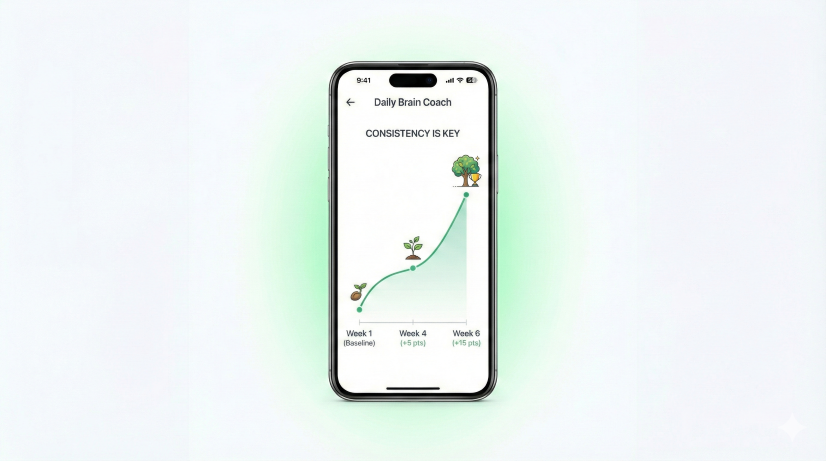
For students, the practical implication is simple: 5 minutes daily beats 45 minutes once a week. The brain responds to frequency, not duration. This is why the Daily Brain Coach session format is capped at 5 minutes — it's designed to fit between classes, not replace a study block.
ADHD vs. Distraction: Does It Matter?
Short answer: less than you think, for the purposes of focus training.
The prefrontal circuits targeted by these exercises are under-activated in both clinical ADHD and in neurotypical students under stress or sleep deprivation. Diamond & Ling (2016, Current Opinion in Behavioral Sciences) showed that executive function training produces similar improvements regardless of baseline diagnosis — the mechanism is the same.
This doesn't mean brain training replaces medication for clinical ADHD. But it does mean these exercises are genuinely useful for anyone whose attention falters under academic pressure.
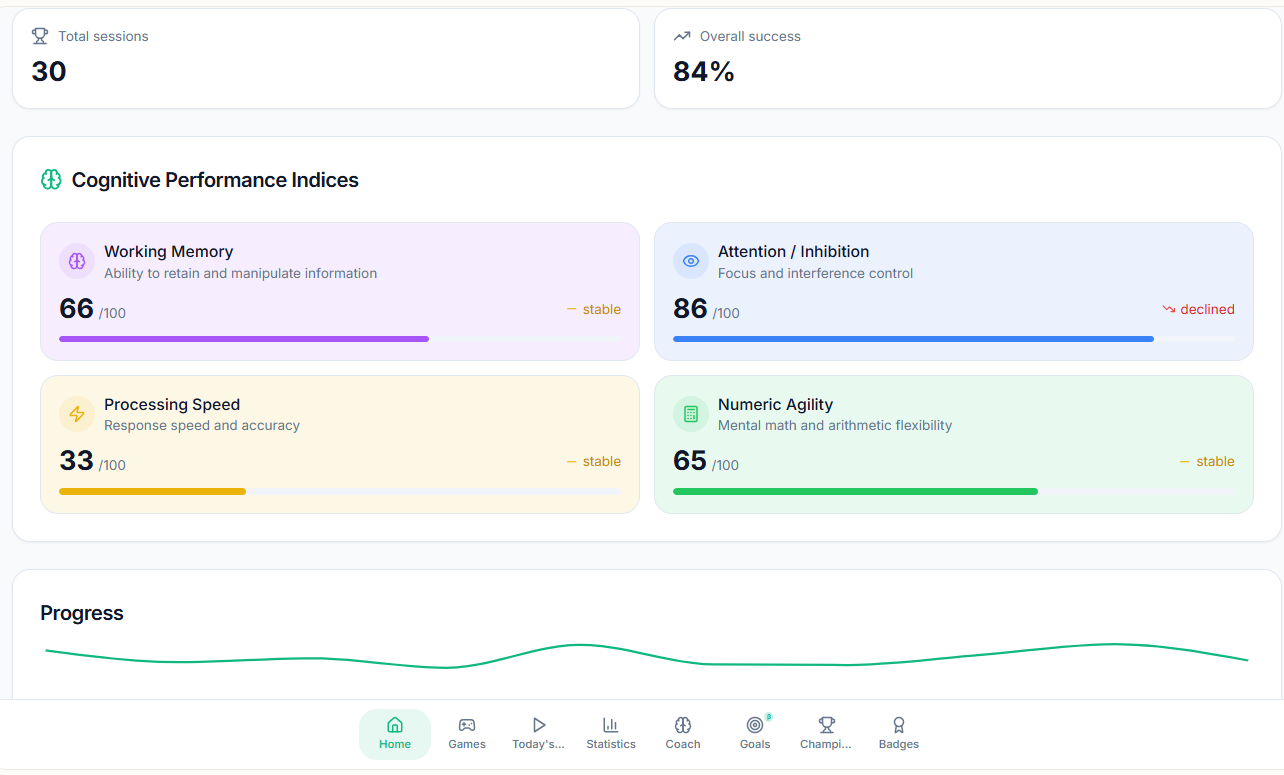
Tracking Progress: The Cognitive Dashboard
The only way to know if training is working is to measure it. Subjective feeling ("I think I'm more focused") is unreliable — you're often most confident right after a study session, which is exactly when fatigue makes you least accurate.
The cognitive indices dashboard tracks four measurable dimensions:
- Attention index — based on Stroop and inhibition performance
- Speed index — based on symbol search and calculation speed
- Memory index — based on N-Back and sequence recall
- Numeric index — based on calculation precision under time pressure
Seeing a number go up (or down) over 30 sessions is more motivating — and more honest — than any streak counter.
The Daily Brain Coach Routine
- Micro-dosing: 2 to 5 minutes per session.
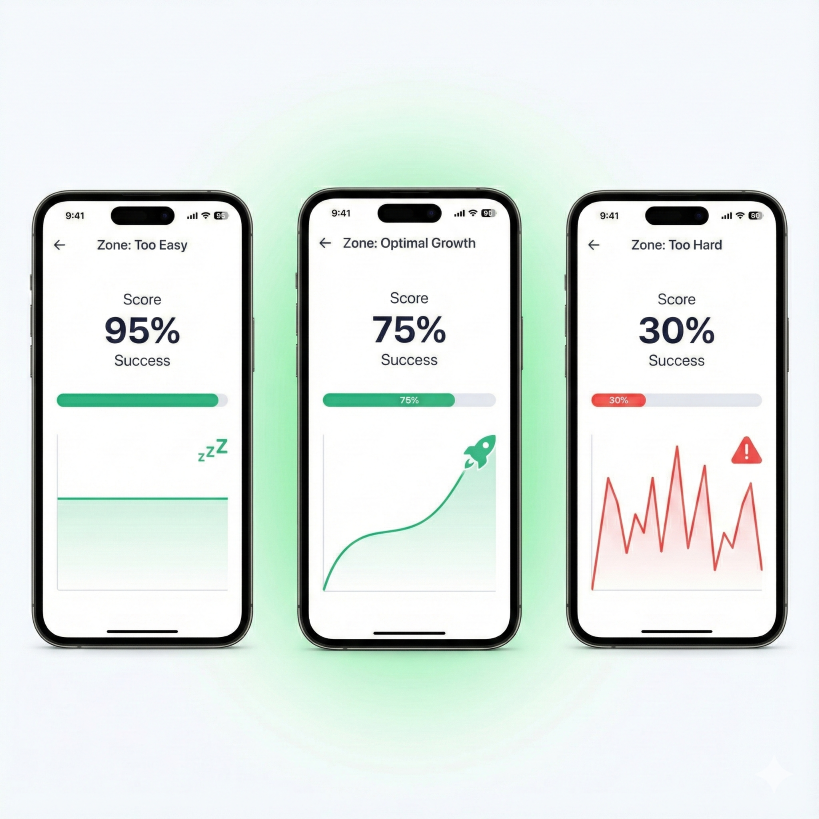
- Adaptive difficulty: Games get harder as you improve — the Zone of Proximal Development applied to cognition.
- Progress tracking: Four cognitive indices updated after every session.
Start your free brain training session — no account required, no credit card.
Conclusion
Position 10 on Google for "brain training app focus" means one thing: people are searching for exactly what this does. The six games above aren't chosen arbitrarily — they map directly to the prefrontal circuits that determine how well you absorb, retain, and apply information under exam pressure.
Start training the cognitive skills that actually impact your ability to learn. Begin your daily brain training for students.
Ready to sharpen your mental edge? Train now — it's free.