
10 Simple Activities to Break the Routine with Your Loved One.
We all know that "use it or lose it" applies to the brain.
For seniors, regular cognitive stimulation is key to maintaining independence and slowing decline. But coming up with new activities every day is exhausting. Here is a practical guide to 10 brain games you can do at home, both analog and digital.
10 Games to Spark Joy & Neurons
- Reminiscence with Photos: Go through an old album. Ask who, where, and when. This stimulates long-term memory.
- The "Grocery List" Game: List 5 items, wait 2 minutes, and ask for them back. (Working Memory).
- Category Naming: "Name as many animals as you can in 1 minute." (Verbal Fluency).
- Card Sorting: Sort a deck by suit or color. (Executive Function).
- Spot the Difference: Visual attention tasks.
- Simple Math: Calculate the tip or change from a receipt.
- Word Association: "I say 'Salt', you say..."
- Music Quiz: Play a song from their youth; ask for the title.
- Puzzle Assembly: Spatial reasoning.
- Symbol Search: Find all the red squares on a page.
Best Brain Training App for Dementia Caregivers & Their Loved Ones
Digital Version: Daily Brain Coach
Don't have time to prep materials? Daily Brain Coach has digitized the best of these mechanics into 2-minute mini-games:
- Analog Game: Card Sorting → App Game: Symbol Search.
- Analog Game: Grocery List → App Game: Visual Memory Sequences.
- Analog Game: Simple Math → App Game: Mental Math Bursts.
Weekly Routine Template
- Mon/Wed/Fri: 5 min of Daily Brain Coach (Morning).
- Tue/Thu: 15 min of Photo Reminiscence (Afternoon).
- Weekend: Music & Social connection.
For more on how brain training helps caregivers themselves, see our guide on brain training for caregivers to reduce stress.
Why These 10 Activities Work: The Science Behind
These activities are not chosen randomly — each targets a specific neural circuit:
| Activity | Circuit targeted | Primary benefit |
|---|---|---|
| Photo reminiscence | Hippocampus, temporal cortex | Episodic memory, language |
| Object sorting | Prefrontal cortex, cerebellum | Executive functions, fine motor |
| Songs / proverbs | Semantic networks | Procedural and emotional memory |
| Grocery list recall | Dorsolateral prefrontal cortex | Working memory |
| Sensory trail | Somatosensory cortex | Multisensory integration |
Multisensory stimulation (touch + sight + sound simultaneously) is especially effective because it activates multiple networks in parallel, promoting cross-regional connections. Research on cognitive reserve shows: the richness of connections matters as much as their strength.
Adapting Activities to the Cognitive Level
| Level | Recommended activities | Max duration |
|---|---|---|
| Normal aging | All 10 activities | 20–30 min |
| Mild MCI | Photo album, songs, simple sorting | 10–15 min |
| Early dementia | Familiar songs, sensory trail | 5–10 min max |
General rule: stop before fatigue, not after. A stop sign: when your loved one starts searching for words or showing slight agitation.
Integrating Daily Brain Coach Into the Routine
Daily Brain Coach games mechanically reproduce the benefits of these activities, with the added advantage of automatic measurement:
- Letter Memory ≈ card matching / object sorting
- Stroop Test ≈ inhibition drills
- Mental math ≈ supermarket estimation
- Word Search ≈ visual scanning
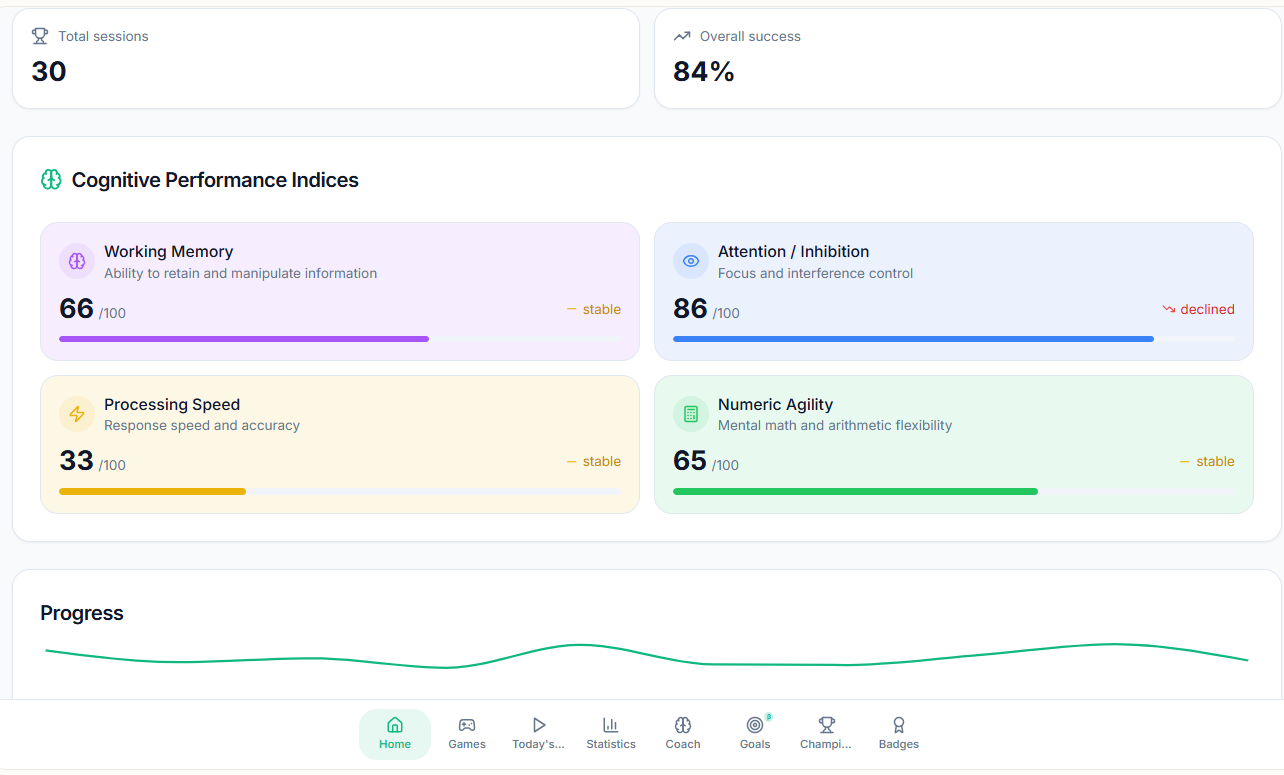
After each session, cognitive indices provide an objective measure of progression — useful to share with a doctor or speech therapist.
Try these games in Daily Brain Coach — free trial, no sign-up.